

Written by
CoachingKhojo Team
Updated on:
25/05/2026
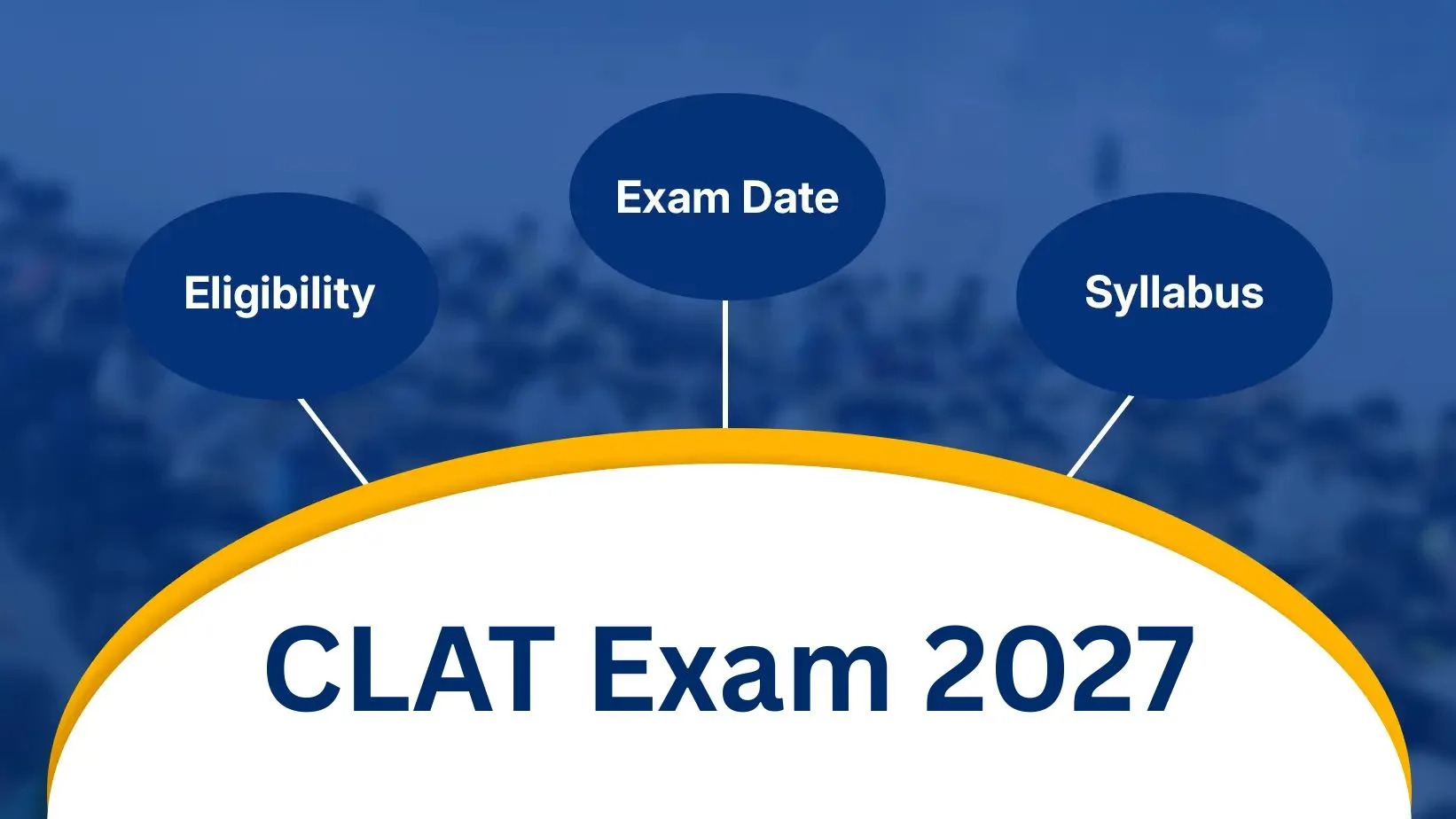
If you are planning to become a lawyer and want to join a top law school in 2027, the Common Law Admission Test (CLAT) is the most important exam for you. CLAT is a national-level entrance test used for admission into 24 National Law Universities (NLUs) and many other top private law colleges across India. The CLAT 2027 exam is expected to be held in December 2026. This means students currently in Class 12 (academic year 2026-27) will take this test to secure their college seats for the following year. It is a highly competitive exam that tests your reading, logical thinking, and legal aptitude rather than just textbook knowledge.
The following table provides a quick look at the CLAT exam structure to help you plan your preparation journey.
|
Feature |
Details About CLAT 2027 |
|
Exam Name |
Common Law Admission Test (UG) |
|
Organizing Body |
Consortium of National Law Universities (NLUs) |
|
Exam Date (Tentative) |
First Sunday of December 2026 |
|
Mode of Exam |
Offline (Pen and Paper) |
|
Duration |
120 Minutes (2 Hours) |
|
Total Questions |
120 Multiple Choice Questions (MCQs) |
|
Language |
English |
|
Marking Scheme |
+1 for correct; -0.25 for incorrect answers |
|
Official Website |
To apply for the undergraduate law program through CLAT 2027, you must meet these simple criteria:
The CLAT 2027 syllabus is divided into five sections. Most of the paper is based on reading passages (about 450 words each) followed by a series of questions.
This section checks your reading comprehension. You will be asked to identify the main point of a passage, understand word meanings in context, and follow the author's arguments.
This includes news from mainstream media and non-fiction books. You’ll need to stay updated on national and international events, legal developments, and general history/arts.
Top Blogs
You don't need to know the law in-depth before the exam. You will be given a set of facts and a legal principle. Your job is to apply that principle to the facts and reach a logical conclusion.
This section tests how you identify patterns, recognize arguments, and draw conclusions from short passages. It’s all about how your brain solves puzzles with words.
This is basic 10th-standard math. You will get data in the form of charts, graphs, or tables and use basic arithmetic (percentages, ratios, averages) to solve them.
Here is how the 120 questions are distributed across different subjects:
|
Section |
Questions (Approx.) |
Weightage |
|
English Language |
22-26 |
20% |
|
Current Affairs & GK |
28-32 |
25% |
|
Legal Reasoning |
28-32 |
25% |
|
Logical Reasoning |
22-26 |
20% |
|
Quantitative Techniques |
10-14 |
10% |
|
Total |
120 |
100% |
The registration process usually starts in July or August 2026.
Also Read:
The fee must be paid during the online registration process.